
 / All Events
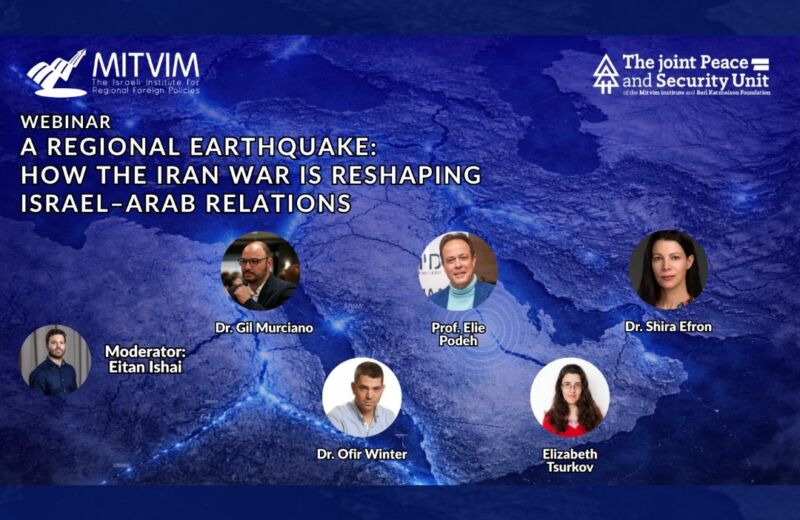
Can military power translate into regional partnerships – or does it deepen mistrust? This question stood at the center of a recent webinar hosted by the Mitvim Institute, titled “A Regional Earthquake: How the Iran War Is Reshaping Israel-Arab Relations.”
Bringing together leading experts, the discussion examined how the ongoing war is transforming regional dynamics-and testing one of Israel’s core strategic assumptions: “normalization through strength.”
“Normalization Through Strength” Put to the Test
Opening the discussion, moderator Eitan Ishai framed the central dilemma: “The idea that military strength… can not only defend Israel, but also help shape its regional environment and even serve as a foundation for normalization and cooperation with Arab states.” But the current war, speakers argued, is challenging that assumption.
Dr. Gil Murciano highlighted a key limitation: “We are starting to experience… the inability to turn temporal military victories… into long-term political achievements.” He also described how Israel is increasingly perceived across the region: “They refer to it as a weak bully-a country that can do whatever it wants on the military level but then can offer absolutely nothing… on the diplomatic side.”
Lebanon: A Rare Political Opening
One of the most striking developments discussed was the situation in Lebanon.
According to Elizabeth Tsurkov, the war has created unprecedented internal pressure on Hezbollah: “This is definitely an unprecedented time… we saw significant cracks… and unprecedented criticism of Hezbollah among the Shia community.” At the same time, the Lebanese government has taken unusual steps, including moves against Hezbollah and signals of openness to talks with Israel.
However, she warned that this opportunity may be missed: “What is the worst case scenario is that Israel will again rely solely on military power without… diplomacy.” And she cautioned against repeating past mistakes: “We will reach a situation… like the ‘security belt’… which was an utter disaster.”
Her key recommendation: “It is crucial that as Israel uses military force, it is accompanied by negotiations.”
Jordan: Partner-and Deeply Concerned
Dr. Ofir Winter presented a more cautious and even тревож picture from Jordan. While security coordination continues, public perception is increasingly negative: “Israeli power is often perceived as aggression… and as a threat of regional superiority and hegemony.”
The deeper concern, he explained, is political: “The belief that the Israeli current government may use the war… to reshape the Palestinian arena.”
This includes fears of annexation and even displacement toward Jordan.
Despite ongoing cooperation, he emphasized: “The core issue is not the Israeli power per se, but its perception.” And concluded: “Israel cannot rely on military power alone… it must also invest in soft power.”
The United States: Support with Reservations
Dr. Shira Efron pointed to a growing gap between Israeli and American strategic thinking: “There is a difference between how… the American public see strength and how Israel [does].” While the U.S. continues to support Israel, Washington expects force to serve diplomacy-not replace it.
She also warned of declining public support in the U.S.: “There’s a lack of support for this war… they felt like they sleepwalking into this operation.” And raised a strategic concern: “If… Israel is perceived as a bully… this is going to affect Israel-U.S. relations in the long term.”
Gulf States: Between Fear and Reassessment
Professor Elie Podeh described a surprisingly cautious response from Gulf countries.
Despite expectations, many avoided direct involvement: “They fear very much from the consequences… and assess that the Iranian regime is not going anywhere.” He identified three dominant perceptions of Israel in the region: Israel as a hegemonic “bully”, Israel and Iran both as destabilizing forces. A minority view supporting closer ties (mainly in the UAE).
His conclusion: “The other two voices are more dominant.” Meaning-normalization is far from guaranteed.
The Bottom Line: Power Alone Is Not Enough
Across the discussion, a clear consensus emerged: military strength remains essential-but insufficient.
As one of the core insights of the webinar suggests: Regional stability cannot be built on force alone.
Without diplomacy, trust, and a shared political vision, even significant military achievements may fail to translate into lasting change.

