
 / All Events
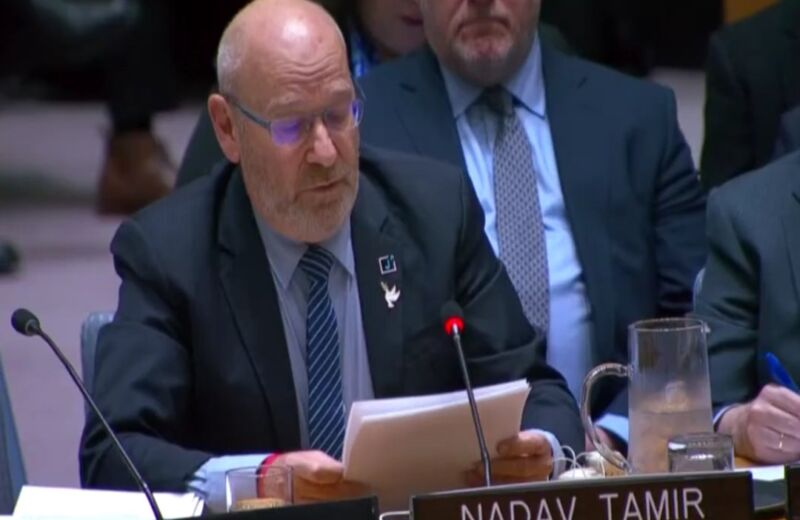
At the invitation of the United Kingdom, currently serving as President of the UN Security Council, Mitvim board member Nadav Tamir delivered a special briefing to Council members alongside Hiba Casas, founding Executive Director of the Principles for Peace foundation and a partner in the Uniting for a Shared Future coalition.
Opening his remarks, Tamir thanked the United Kingdom for convening the session and addressed the Council as “an Israeli patriot and a Zionist,” and as a member of the Israeli-Palestinian coalition Uniting for a Shared Future (USF).
Tamir emphasized that despite the deep trauma experienced by Israelis and Palestinians since the October 7 attacks and the war in Gaza, the current moment presents “a historic opportunity, one that must not be missed.”
He called for translating the growing international urgency into “a clear and irreversible pathway toward the demilitarized Palestinian state alongside Israel,” embedded within a broader regional framework that promotes normalization and marginalizes extremist actors.
Tamir described this vision as effectively a “23-state solution” – Israel, Palestine and the 21 Arab states that endorsed the Arab Peace Initiative – working together for mutual security and prosperity.
Importantly, he stressed that Israeli public opinion is more pragmatic than often assumed. Citing surveys by the Accord Center at the Hebrew University, Tamir noted that a majority of Israelis would accept a Palestinian state if embedded within a comprehensive normalization agreement. “Approximately 61 percent of the public prefers separation from the Palestinians over annexation,” he said.
“This data indicates,” Tamir added, “that ultimately, even when the winds of war are blowing, the Israeli public is much more realistic than its current leadership.”
He warned that Gaza cannot be treated in isolation and urged the Security Council to support advancement of the regional political framework while explicitly including the West Bank, which he described as being at serious risk of escalation.
“While global attention is understandably focused on Gaza,” Tamir cautioned, “the West Bank is at serious risk of explosion.”
He further argued that diplomacy is essential for weakening Hamas’ hold on Gaza. “The most effective way to remove Hamas from its brutal control of Gaza,” Tamir said, “is through a credible diplomatic process and the creation of a genuine political horizon for the Palestinian people.”
Framing the moment historically, he noted: “History shows that trauma can be transformed into opportunity – if leadership is courageous and the international community is resolute.”
Alongside Tamir, Hiba Casas presented the work of the Uniting for a Shared Future coalition, which brings together more than 550 Israeli and Palestinian leaders from politics, security, business, civil society and media.
Casas stressed the coalition’s core premise that the current reality is untenable. “The status quo is not sustainable for either people,” she told Council members. “Neither side can have lasting security, dignity and prosperity at the expense of the other.”
She emphasized the coalition’s approach: “We do not relativize pain and we do not dehumanize the other. We are realists, we are possibilists and we are patriotic pragmatists in equal measure.”
Casas highlighted the need to link Gaza recovery with developments in the West Bank within a time-bound political framework, warning that “Gaza cannot succeed if the West Bank collapses.”
She outlined priority steps for the international community, including improving humanitarian access, restoring Palestinian fiscal functionality, supporting governance reform and elections, deterring violence and enabling legitimate transitional governance in Gaza.
Both briefers underscored that resolving the Israeli-Palestinian conflict is essential for broader regional stability and integration.
“Our futures are interdependent,” Tamir said, urging the international community to help translate political intent into concrete steps toward a negotiated future grounded in mutual recognition and regional cooperation.

