
 All Publications
/ Israel and China
All Publications
/ Israel and China
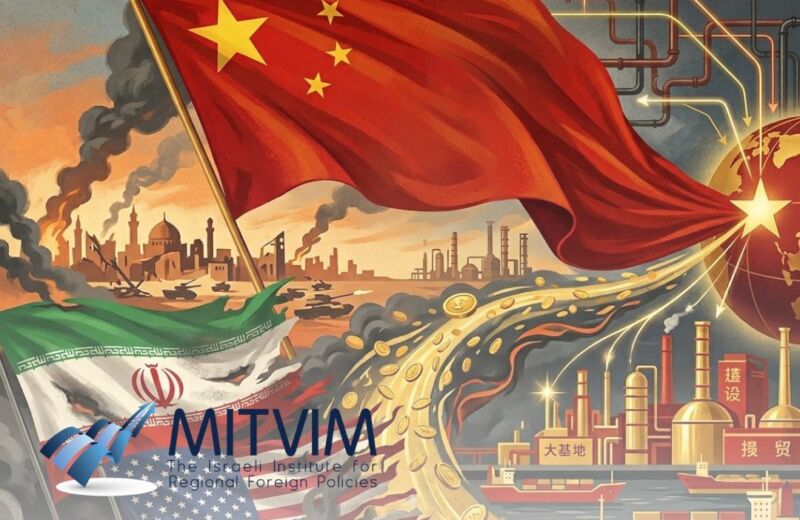
The campaign in the Persian Gulf underscores the urgent need to transition away from oil and gas. Beyond the issues of pollution and global warming, dependence on fossil fuels is fundamentally a dependence on vulnerable transport infrastructure – shipping lanes and pipelines that pass through the world’s most unstable regions. While China and Europe have already recognized this reality, Donald Trump and the United States risk being left behind.
The Great Game: Energy and Hegemony
The United States, currently the world’s largest producer of oil and gas, has already secured access to Venezuela’s natural resources. Should its military seize Kharg Island and take control of the majority of Iranian oil, the U.S. would control over a third of global oil reserves and approximately a quarter of gas reserves. This would constitute an extraordinary geopolitical force multiplier, especially if the U.S. effectively controls tanker traffic through the Strait of Hormuz.
Why does the United States seek this dominance? In a word: China. As the primary challenger to global hegemony, China relies on the Strait of Hormuz for more than half of its oil consumption and a third of its imported LNG. Control over these sources would provide the U.S. with significant leverage over Beijing. However, China holds several strategic cards of its own.
China’s Strategic Transition
China has long prepared for such contingencies. It maintains oil reserves sufficient for four months of consumption and remains the world’s largest coal producer. While this reliance on coal makes China the world’s leading polluter – responsible for over 30% of global greenhouse gas emissions in 2025 – it is also executing an impressive pivot toward clean energy.
China is rapidly establishing itself as the undisputed superpower of the green transition:
Electric Vehicles (EVs): In 2024, China produced over 70% of the world’s EVs. Chinese brands now account for 40% of global exports in this sector. Half of the vehicles sold in China that year were electric. It’s economical for most consumers: 80% of electric models are cheaper than their internal combustion engine counterparts, and 100% of small cars are.
Solar and Wind: China manufactured approximately 85% of the world’s solar panels in 2024 and added 59% of all new global solar capacity. In 2025 alone, it installed 119 GW of wind capacity – double the rest of the world combined.
Economic Impact: Clean energy technologies accounted for over 11% of China’s GDP last year and contributed $1.9 trillion to its economy – roughly the size of the entire annual GDP of Australia or Mexico.
Today, 42% of China’s electricity comes from non-fossil sources. By contrast, the United States under President Donald Trump has retreated from global climate leadership, withdrawing from the Paris Agreement, canceling EV incentives, and rolling back renewable energy projects in favor of the fossil fuel industry. This policy shift has created a geopolitical vacuum that China has moved to fill.
Critical Minerals and Technological Leverage
Beyond energy production, China has spent three decades securing dominance over the entire value chain of critical minerals (lithium, cobalt, graphite, and rare earths). These materials are essential for advanced semiconductors, AI, aerospace, and modern weaponry. The West remains dangerously dependent on China for every link in this chain.
This dependency is heightened by the looming threat regarding Taiwan. The TSMC foundry in Taiwan produces over 90% of the world’s most advanced semiconductors. Should Taiwan fall under Chinese control, the global technological and military balance of power would be fundamentally upended. Furthermore, China is reportedly reverse-engineering ASML’s advanced lithography machines in order to bypass Western monopolies on chip production.
Economic De-risking and Financial Weapons
China is also systematically reducing its dependence on the United States. Despite a 20% drop in exports to the U.S. in 2025 due to trade wars and tariffs, China successfully redirected its trade to Africa, Southeast Asia, and Europe. Its trade surplus reached a historic record of nearly $1.2 trillion last year.
Moreover, China holds a potent financial weapon: U.S. Treasury bonds. As the U.S. national debt reached $38 trillion at the end of 2025, China has been gradually reducing its holdings, unravelling the economic ties between the two giants and potentially complicating the future financing of American debt.
Lessons from the European Precedent
How will the current war in the Gulf impact the global transition to renewables? We can look at Europe’s response to the Russian invasion of Ukraine as a blueprint. Through the “RePowerEU” initiative, the EU reduced its reliance on Russian gas from 45% to just 13% by 2025. By the end of last year, 71% of Europe’s electricity was generated from clean sources (renewables and nuclear).
The war in Iran is likely to accelerate this global trend. It does not take an expert to realize that fossil fuel dependence is synonymous with vulnerability. Pipelines and maritime routes are easily disrupted in unstable regions.
Conclusion
If humanity is to ensure its long-term security, it must break its addiction to fossil fuels. While the United States gambles on the industries of the past, China is securing the technologies of the future. The aftermath of the war in Iran will likely see China emerge as the global “locomotive” of the energy transition, leaving those dependent on traditional energy routes exposed and weakened.

