
 All Publications
/ Israel and Turkey
All Publications
/ Israel and Turkey
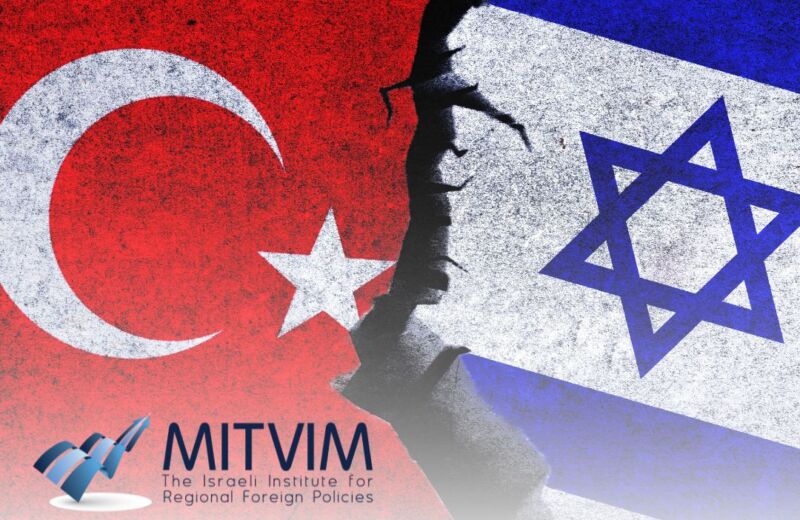
Ties between Israel and Turkey had their historical share of ups and downs. Since the Hamas attack of October 7, 2023, however, they suffer unprecedented setbacks. These require Israel and Turkey to showcase resilience, resist claims that they are doomed to become even harsher rivals, seek opportunities to improve ties, and act to fulfil them.
This article presents the evolution and determinants of Israel-Turkey relations, reviews the strained ties in the wake of October 7 and the war in Gaza, identifies to ousting of Bashar al-Asad in Syria as a catalyst for both competition and coordination, and presents a future-oriented outlook on mending relations.
The evolution and determinants of bilateral relations
Turkey was the first Muslim country to recognize Israel, in 1949, and the countries maintain uninterrupted diplomatic ties – albeit at varying levels of representation – ever since.
The Turkish decision to recognize Israel was impacted by positive historical narratives, including the Ottoman Empire’s welcoming of Jews expelled from Spain in the late 15th century, Turkey’s safeguarding of Jews who fled the Nazi regime in Germany, and the fact that prominent Zionist leaders – including David Ben Gurion – pursued academic studies in Istanbul. Contemporary geopolitical considerations also impacted Turkey’s early attitudes towards Israel: Turkey’s Westernist approach, shaped by Mustafa Kemal Atatürk’s legacy under post-World War II realities and consolidated by Turkey’s accession to NATO in 1952, as well as Turkish-Arab grievances and tensions.
Throughout the decades, Turkey-Israel relations managed to overcome significant crises and differences. At times, relations were more discreet than in the public eye, with security cooperation overshadowing diplomatic, civilian and economic ties. The level and scope of Israel-Turkey relations has been traditionally linked to the state of Turkey-Arab relations and to developments in the Israeli-Palestinian conflict and peace process (with Gaza and Jerusalem being recurring issues of bilateral contention).
Israel-Turkey relations took a downturn in the early 1950s, when Turkey drew politically closer to the Arab world; in the mid-1960s and 1970s, when Turkey became more economically dependent on Arab oil; in 1980, when Israel annexed east Jerusalem; in the 2000s, following Israel’s military reactions to the Palestinian al-Aqsa Intifada; and in the 2010s, following rounds of Israel-Hamas clashes around Gaza. Ties were never cut, but suffered downgrades of diplomatic representation, negative mutual rhetoric, and limits on cooperation.
In contrast, when Israel made progress towards peace and normalization with the Palestinians and Arab countries, such as the 1991 Madrid Conference, the 1993 Oslo Accords, and the 1994 Israel-Jordan peace treaty – Israel-Turkey ties peaked. It is not by chance that Israel and Turkey signed a series of strategic agreements in the mid-1990s, and that their relations during that decade were celebrated in public, expanded to non-security sectors, and mobilized people in both countries to adopt warm views of the other.
Strategic considerations and similar threat perceptions were historically a strong factor in fostering Israel-Turkey cooperation. As early as 1958, the two non-Arab and largely-secular countries in the region agreed behind-the-scenes to cooperate in an “Alliance of the Periphery“. In later decades as well, shared strategic concerns – related to Iran, Syria, terror attacks, separatist movements, and religious fundamentalism – generated bilateral alignments.
The Palestinian issue drove a wedge in ties, especially after the coming to power in 2002 of the Justice and Development Party (AKP). Under the leadership of Recep Tayyip Erdoğan, Turkey turned more conservative/religious at home, became sympathetic towards Muslim Brotherhood movements such as Hamas, and aspired for prominence within post-Arab Spring Middle East geopolitics. This, coupled with Israel’s turn to the right and the increased escalation of the Israeli-Palestinian conflict, led to crises in ties.
Problems piled up, with the Davos incident (2009) and the Mavi Marmara Flotilla (2010) leading to a deep rupture and a downgrade of ties. A rapprochement agreement reached in 2016 was short-lived, as tensions over Gaza and Jerusalem quickly generated another crisis, in 2018. This crisis, too, was overcome via a gradual and cautious rapprochement process finalized in 2022, enabling a return to ambassadorial level ties and eventually leading Benjamin Netanyahu and Erdoğan to meet in New York in September 2023, pledging to enhance cooperation.
Some 20 days later, the Hamas terror attack of October 7 shattered this positive momentum.
Strained ties in the wake of October 7 and the war in Gaza
Since the Hamas takeover of Gaza from the Palestinian Authority in 2007, and throughout escalation cycles between Israel and Hamas that followed, Turkey sought to play a Gaza-related diplomatic role. It offered mediation services, which were rejected by both Israel – due to Erdoğan’s pro-Hamas stand – and Egypt – due to its desire to safeguard the main mediator role and to its strained relations with Turkey at the time.
When Israel-Turkey reconciled in 2016, bringing the Gaza Flotilla incident to a close, the bilateral agreement enabled Turkey to step up support for the Palestinians in Gaza. Turkey, however, did not fulfil this opportunity. Domestically, Erdoğan sought political gains by positioning himself against Israel on Gaza. Whenever he tried to mend ties with Israel, a key justification of his was that it would enable Turkey to be more influential on the Palestinian issue. After October 7, too, Turkey wanted a diplomatic role to play.
The chances for this to happen were more favorable than before. At the time, Turkey had better relations with both Israel and Egypt, compared to previous Israel-Hamas confrontations. Turkey thus expected both countries to be less opposed to its involvement. Erdoğan was one of only two regional leaders (the second being from the UAE) who called Israeli President Isaac Herzog following the Hamas attack. But, this sign of goodwill quickly lost traction, as two days later the Turkish President bashed Israel for committing a massacre in Gaza. Turkey’s harsh criticism of Israeli actions intensified in the months to come. In parallel, Turkey advocated that it should become an official guarantor of the Palestinians.
Israel rejected Turkish involvement in Gaza-related diplomacy, and bilateral rhetoric turned negative by the day. The Biden Administration, though, was willing to examine what Turkey could contribute. In early shuttle diplomacy visits to the region during the war in Gaza, US Secretary of State Antony Blinken also visited Turkey, but this practice did not yield diplomatic results and was eventually dropped.
Israel-Turkey ties deteriorated as the war lingered. Leaders exchanged negative public messages, Turkey limited trade with Israel, mutual representations in diplomatic missions was de facto downgraded, direct flights stopped, connections between societies nearly came to a halt, and anti-Israeli mass protests in Turkey became widespread. Official ties continued, but without meaningful content. It was a low point in relations, sparking concerns in both countries that a clash is approaching.
US President Donald Trump’s efforts to end the war in Gaza and advance his 20-Point Plan provided Turkey the involvement it sought for years. Trump embraced Erdoğan, due to their personal affinity and Trump’s assessment that Erdoğan has leverage over Hamas. Turkey officially became one of the mediating countries supporting US efforts (alongside Egypt and Qatar), became a member of the Board of Peace, and its Foreign Minister Hakan Fidan was appointed to the Gaza Executive Board.
Symbolically, this was meaningful for Turkey. In Israel, however, it raised fierce opposition. Netanyahu conveyed to Trump a red line against Turkey sending troops to Gaza, which the US respected. Turkey got an entry ticket to new international mechanisms dealing with Gaza, but was not given a genuinely impactful status. Once again, its stained ties with Israel blocked Turkey’s possible role on the Palestinian issue. Instead, Turkey aligned itself with a group of like-minded countries (“The Hague Group“) committed to punitive actions against Israel.
Post-Asad Syria as a catalyst for both competition and coordination
Beyond the Palestinian issue, Syria is also a key factor shaping Israel-Turkey relations, being a neighbor of strategic importance to both. Turkey’s Syria-related concerns generally focus on Kurdish nationalism, migration flows, and Russian dominance. Israel’s main worries are the safety of the Golan Heights border, smuggling of weapons to Hezbollah through Lebanon, Iran’s presence and involvement in Syria, and the fate of the Druze community.
Unlike the Palestinian issue, Israeli and Turkish priorities in Syria are less grounded in religious aspirations, emotionally-charged rivalries, or competing ideologies, but rather in national interests and security considerations. Moreover, the primary concerns of Israel and Turkey are on different regions of Syria. While Turkey’s main focus is on Syria’s north (where Kurdish population is concentrated), Israel’s is on the south-west (near its border). These factors soften tensions, ease engagement, and give Israel and Turkey leeway to coordinate actions and exchange information.
The swift and surprising fall of Syria’s al-Asad regime in December 2024 shook the equilibrium. Israel and Turkey had diverging visions on what should come next. Turkey prioritized a unified Syria under a centralized regime led by Ahmed al-Sharaa, and as a Turkish sphere of influence. Israel, on the other hand, opted for a Syria that is fragmented along minority divisions, kept weak, not under Turkish dominance, and enables Israel a high degree of freedom of military action (also as a pass-through for attacks on Iran).
These competing aspirations initially fueled tensions between the countries. Threats were exchanged, condemnations of each other’s actions were voiced, and speculations about a possible Israel-Turkey confrontation inside Syria were on the rise. Former Israeli Prime Minister Naftali Bennett went as far as claiming that “Turkey is the new Iran”. Even though this notion is rejected by multiple Israeli experts, it still shapes public discourse.
In reality, Turkey and Israel seemed to quietly respect each other’s red lines and seek coordination, despite disagreements and rivalry. Bilateral deconfliction talks launched in Azerbaijan, enabling security officials to communicate towards an acceptable modus vivendi. Trump’s support for al-Sharaa lessened Israel’s concerns of future developments in Syria, and the US administration indicated – via the President and his ambassador to Turkey Tom Barrack – its interest in improving Israel-Turkey ties.
Syria might still be a sticking point between Israel and Turkey, but there is also an alternative option. It can also exemplify how both countries overcome grievances and discreetly work together for the benefit of their national interests. To some extent, this is already happening, and can serve as a stepping stone for further progress in ties.
A future-oriented outlook on mending relations
Israel and Turkey currently face a deep crisis and advance competing alliances in the East Mediterranean and Middle East. But, they are not enemies. The countries have continuous diplomatic ties and a proven track record of overcoming differences, they hold shared interests and needs across sectors, and are both US allies (Turkey also being in NATO). Related policy discussions should thus focus on improving ties rather than mistakenly portray further escalation as inevitable.
The best pathway to improvement lies in progress towards Israeli-Palestinian peace. This will enable Israel to better integrate in the region and improve bilateral relations with neighboring countries, Turkey included. A change of leadership in Jerusalem, resulting in a moderate coalition that will marginalize extremists, will also be a major contributing factor. So will a clear distancing of Turkey from support to Hamas and a mutual toning down of harsh conflictual rhetoric.
Israel-Turkey rapprochement has failed twice over the past decade, so the next attempt may be even more gradual and cautious than before. Israelis will be suspicious of whether improved ties are at all feasible and whether they can be sustained for the long run, especially while Erdoğan is still in power. To counter that, priority should be given to resuming trade, flights, civil society interactions, track-two diplomacy, exchanges in academia, culture and sports, cooperation on climate and energy, and engagement via regional organizations like the Union for the Mediterranean.
Most importantly, Israelis and Turks should remember that their ties must not be dictated by policies and attitudes of current leaders. Societies are diverse, and various types of connections could be possible. For example, liberals in both countries found common ground when exchanging lessons and practices from their parallel struggle against democratic backsliding. Additional commonalities exist, and should be identified and acted upon by those – in Israel, Turkey, and the international community – who care about this relationship and seek to get it back on track.

